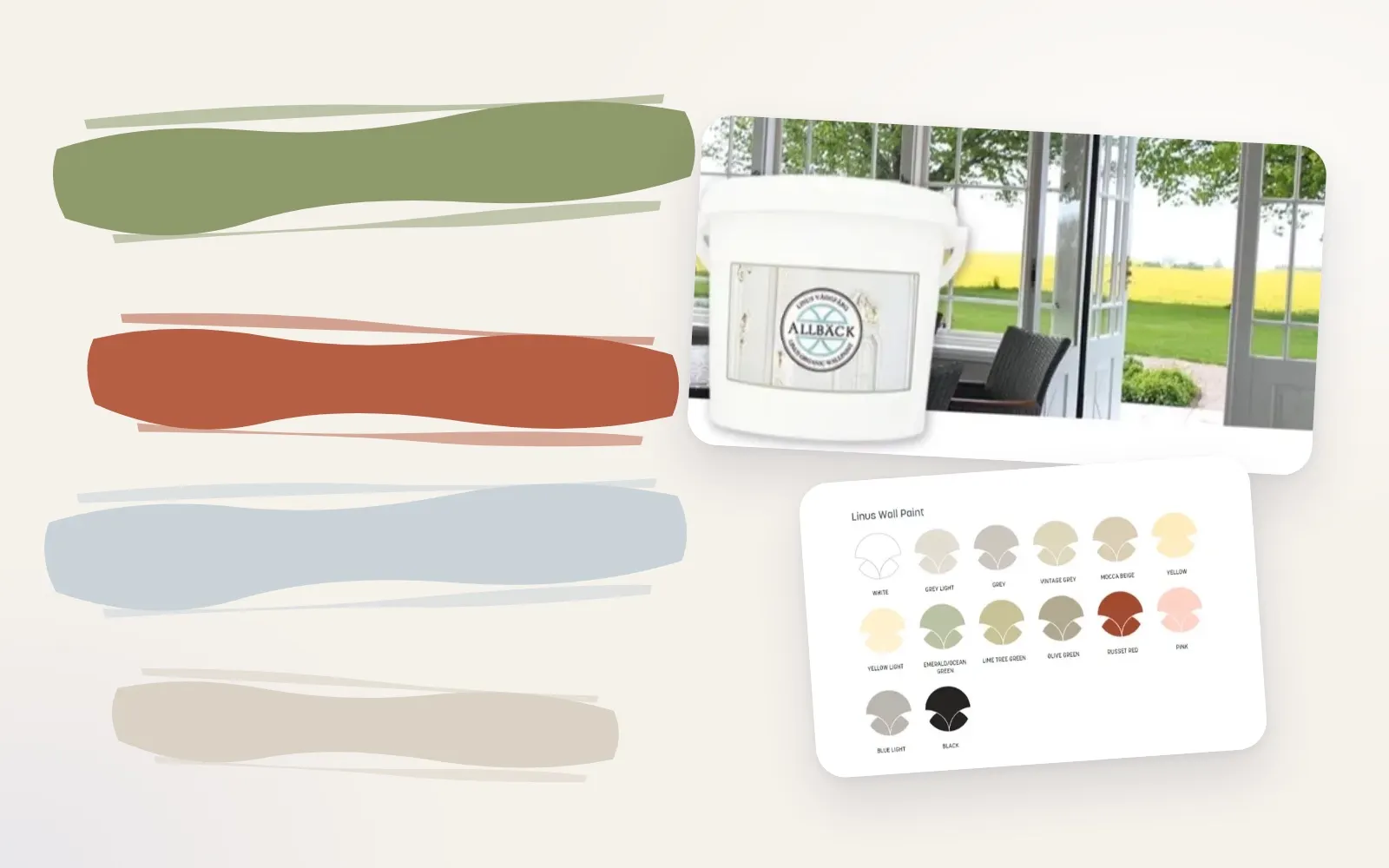
Linus is Allbäck’s interior wall paint: a completely matte, solvent-free paint made with linseed oil, water, cellulose glue, shellac and natural pigments. It gives walls and ceilings the soft, chalky-matte look of traditional paints, is easy to touch up, and is made from the same family of ingredients as Allbäck’s linseed oil paint.
Where you can use Linus
Linus is for interior surfaces only. It can be used on:
- Plaster and plasterboard walls and ceilings
- Previously painted surfaces, including over many modern wall paints
- Wallpaper and woven wall coverings
- Timber panelling and fibreboard
- Around fireplaces and behind wood heaters — Linus withstands heat
It is also used on furniture: paint with Linus, sand lightly once dry and finish with linseed oil wax for a durable, washable, silky-matte surface.
Colours
We stock 14 Linus colours in 1 litre and 3 litre tubs, from White and Vintage Grey to Olive Green, Russet Red and Blue Light. All Linus colours can be mixed with each other to create new shades. Linus cannot be mixed with linseed oil paint.
Coverage and drying
- Coverage: about 10–12 m² per litre, depending on the surface and the texture you want.
- Coats: at least two.
- Drying: about 24 hours between coats at room temperature with good ventilation.
- Full hardness: a few weeks — be gentle with cleaning at first.
A typical 4 × 4 m bedroom with 2.7 m ceilings has roughly 40 m² of wall. Two coats at 10–12 m² per litre comes to about 7–8 litres.
Preparing the surface
- Surfaces should be clean, dry and stable. Wash with linseed soap and water and let dry.
- Very absorbent surfaces such as raw plaster or woven coverings can be primed with Allbäck Primer (a water-based shellac primer), 1–3 coats, which dries in 1–2 hours. Primer also stops old water stains, soot and nicotine bleeding through.
- Fill holes and uneven joints with Linus itself: pour off the surface water and mix in about 50% pumice powder to make a filler that can be rolled on and wet- or dry-sanded.
How to apply Linus
- Stir. The tub has a layer of water on top. Stir it into the paint. Add up to about 10% more water if you want a smoother finish.
- Use a yarn roller or brush. A long-pile yarn roller holds plenty of paint and works on all surfaces. Compact foam or short-pile rollers do not release enough paint and leave streaks at the edges. Test first.
- Cut in first, then roll the wall in sections of about one metre at a time, keeping the roller well loaded.
- Keep the room cool. Linus dries fairly quickly, so working in a cool room helps you keep a wet edge.
- Ventilate. There can be a strong linseed smell while the paint dries, as oil oxidises and water evaporates. It can irritate the eyes. Keep windows open — the smell fades.
- Second coat after about 24 hours. On very absorbent surfaces the first coat may look chalky; this disappears once you finish painting.
Between coats, leave the roller in the paint overnight, or wash it. Wash tools in a bucket of soapy water first rather than straight down the sink, let the residue settle, then pour off the water and put the residue in the general rubbish.
Texture and effects
Linus is quite thick and can be used in different ways, so decide on the look you want and test a small area first. Rolled undiluted it gives a soft texture; thinned it gives a smoother wall. Undiluted Linus, or Linus with chalk added, is excellent for stencilling. If a coat has dried more textured than you wanted, sand it lightly and paint again with thinner paint.
Yellowing
Like all linseed paints, Linus can yellow slightly where it gets no light — behind a picture or a cupboard, for example. The patch fades when it is exposed to light again. For dark rooms, adding a little grey to light colours helps.
Care and storage
- Once cured, wipe the surface with linseed soap and water.
- Touch-ups blend in easily because the finish is completely matte.
- Store leftover paint with a layer of water on top and the lid tight. Keep it from freezing; it keeps for at least six years at room temperature. Old paint may need straining.
Common questions
Can Linus be used in bathrooms and kitchens?
Linus is wipeable but completely matte. For wet areas, a linseed oil paint emulsion is the traditional choice — ask us about your room.
Can I paint Linus over existing acrylic wall paint?
Yes, Linus can be painted over many modern wall paints. Clean the wall and test a small area first; occasionally the first coat reacts with certain plastic paints and smells more strongly before behaving normally.
Is Linus the same as linseed oil paint?
No. Linus is a water-borne wall paint for interiors; linseed oil paint is for timber, metal and exterior surfaces. They are not interchangeable and cannot be mixed. To compare, see linseed oil paint vs acrylic.